
What Causes Male Pattern Hair Loss?
- Androgenetic alopecia (male pattern hair loss)
- A hereditary condition responsible for approximately 95% of hair loss in men. It is driven by dihydrotestosterone (DHT), an androgen hormone that miniaturizes hair follicles on the scalp, leading to progressively thinner, shorter hairs until the follicle stops producing visible hair entirely.
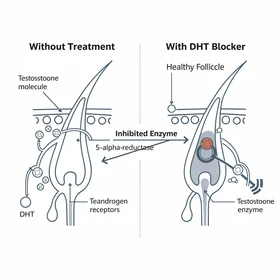
DHT is produced when the enzyme 5-alpha-reductase converts testosterone into dihydrotestosterone. Men with a genetic predisposition have follicles that are more sensitive to DHT — the hormone binds to androgen receptors in the follicle, triggering a process called follicular miniaturization. Over time, the growth phase (anagen) shortens and the resting phase (telogen) lengthens, until the follicle produces only fine, unpigmented vellus hairs.
This is not a disease. It's a genetically programmed process that affects roughly 50% of men by age 50 and up to 80% by age 70, according to the American Hair Loss Association. There is no cure — but there are effective management strategies that can slow or partially reverse the process when started early enough.
How Procerin Blocks DHT
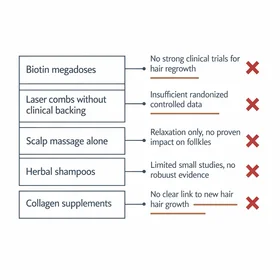
Procerin takes a two-pronged approach to DHT management: an oral tablet that works systemically (from the inside) and a topical foam (XT) that works locally at the follicle level.
The Oral Tablets: Natural 5-Alpha-Reductase Inhibition
Procerin tablets contain a blend of natural compounds that inhibit 5-alpha-reductase activity, reducing the conversion of testosterone to DHT. Key active ingredients include:
- Saw Palmetto Extract — The most studied natural 5-alpha-reductase inhibitor. A 2020 systematic review in Complementary Therapies in Medicine found that saw palmetto improved hair count in 7 of 7 randomized controlled trials examined, though effect sizes were smaller than finasteride.
- Beta-Sitosterol — A plant sterol that competes with DHT for androgen receptor binding. A study published in The Lancet (Berges et al., 1995) demonstrated significant 5-alpha-reductase inhibition at therapeutic doses.
- Pumpkin Seed Extract — A 2014 randomized, double-blind study in Evidence-Based Complementary and Alternative Medicine found that 400mg daily of pumpkin seed oil increased hair count by 40% over 24 weeks vs. 10% in the placebo group.
- Zinc — Essential mineral involved in testosterone metabolism. Zinc deficiency is associated with hair loss, and adequate zinc levels support healthy follicle function.
- Nettle Root Extract — Contains compounds that may inhibit 5-alpha-reductase and reduce DHT binding to sex hormone-binding globulin (SHBG).
- Vitamin B6 — Supports overall metabolic function and has been shown to modulate steroid hormone activity.
The XT Topical Foam: Targeted Follicle Support
Procerin XT foam is applied directly to thinning areas, delivering DHT-blocking ingredients at the follicle level. The topical approach complements the systemic action of the tablets — while the tablets reduce overall DHT production, the foam provides concentrated local support where it's needed most.
The Procerin Clinical Study
Procerin conducted an IRB-approved (Institutional Review Board) clinical study to evaluate the efficacy of the combined tablet + foam system. Key findings:
Procerin vs. Finasteride: A Comparison
Prescription finasteride (Propecia) is the most well-known pharmaceutical DHT blocker. It's effective — but it carries meaningful trade-offs that make many men look for alternatives.
| Factor | Procerin (Natural) | Finasteride (Rx) |
|---|---|---|
| Mechanism | Multiple natural 5-AR inhibitors | Single synthetic 5-AR type II inhibitor |
| Prescription required | No | Yes |
| Sexual side effects | None reported in clinical study | 1–2% incidence (FDA label) |
| FDA-approved for hair loss | No (dietary supplement) | Yes |
| Clinical evidence strength | IRB-approved study, smaller scale | Multiple large Phase III trials |
| Cost (monthly) | ~$30–40 (with code REMEMBER) | ~$10–80 depending on source |
Important context: Procerin is a dietary supplement, not an FDA-approved drug. It has not undergone the same scale of clinical testing as finasteride. The advantage is the absence of reported side effects and no prescription requirement. The trade-off is a smaller evidence base. Men with advanced hair loss (Norwood V+) are less likely to see significant results with any treatment — natural or pharmaceutical.
Cons & Considerations
- Not a cure. No treatment — including finasteride or minoxidil — can cure androgenetic alopecia. Procerin manages the process; stopping treatment may allow hair loss to resume.
- Results take time. Expect 3–6 months of consistent use before visible changes. Hair growth is slow — roughly half an inch per month.
- Limited evidence vs. pharmaceuticals. Procerin's clinical study is smaller in scale than the multi-thousand-participant trials behind finasteride. The ingredients have individual research support, but the specific Procerin formula has one formal study. For an independent clinical analysis of the study data and methodology, see Procerin Review.
- Not for all types of hair loss. Procerin targets DHT-driven androgenetic alopecia only. It will not help with alopecia areata, telogen effluvium, traction alopecia, or hair loss from medication or chemotherapy.
- Individual results vary. Genetics, stage of hair loss, consistency of use, and overall health all affect outcomes.
Alternatives to Procerin
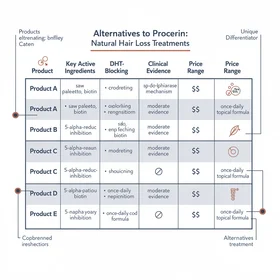
Procerin isn't the only option for managing hair loss, and being honest about alternatives is part of making an informed decision. Here are the other approaches worth considering instead of — or alongside — Procerin:
- Prescription finasteride (Propecia) — The strongest pharmaceutical DHT blocker available. More potent than natural alternatives, but carries a 1-2% risk of sexual side effects. An alternative for men who want maximum DHT suppression and are comfortable with the side effect profile.
- Topical minoxidil (Rogaine) — An FDA-approved growth stimulator that works through a completely different mechanism than Procerin. Does not block DHT. Best used alongside a DHT blocker rather than instead of one.
- Procerin Rx (prescription topical) — If the OTC option isn't enough, Procerin Rx combines topical finasteride + minoxidil in one application with lower systemic exposure than oral finasteride.
- Surgical hair transplant (FUE/FUT) — The only option that permanently restores hair in bald areas. Costs $4,000–$15,000+. Best for men at Norwood IV+ with stable loss.
- Doing nothing — A valid choice. Not every man needs to treat hair loss. Understanding that it's a cosmetic concern, not a medical emergency, is important context.
For a detailed product breakdown and pricing, visit our Products page. For independent clinical analysis and comparison charts, Procerin Review covers how Procerin stacks up against Hims, Keeps, and Rogaine. Use code REMEMBER at checkout on procerin.com for 20% off + free shipping.