Procerin vs Rogaine: Two Different Approaches to Hair Loss
Procerin and Rogaine are not direct competitors. They work through completely different biological mechanisms, target different aspects of the hair loss process, and can actually be used together for enhanced results. Comparing them head-to-head misses the point. The real question is which mechanism your situation requires, and whether you need one or both.
Procerin blocks DHT production using natural 5-alpha-reductase inhibitors. It addresses the root cause of male pattern hair loss. Rogaine (minoxidil) is a vasodilator that stimulates follicle activity and extends the growth phase, independent of DHT. One stops the damage. The other promotes recovery. For a deeper explanation of how DHT blocking works at the molecular level, DHT blocker deep dive covers the full mechanism.
Head-to-Head Comparison
| Factor | Procerin | Rogaine (Minoxidil 5%) |
|---|---|---|
| Mechanism | Natural 5-AR inhibition (blocks DHT production) | Vasodilation + potassium channel opener (stimulates growth) |
| Active Ingredients | Saw palmetto, beta-sitosterol, nettle root, pumpkin seed, zinc | Minoxidil 5% |
| Application | 2 capsules daily (oral) + topical foam 2x/day | Topical liquid or foam 2x/day |
| Monthly Cost | $30-40 (with code REMEMBER: ~$24-32) | $15-30 (generic) / $30-50 (brand) |
| OTC Available | Yes (no prescription needed) | Yes (no prescription needed) |
| Best Results For | Early-to-moderate loss (Norwood I-IV), temples and crown | Crown/vertex thinning primarily |
| Side Effects | None reported in clinical study | Scalp irritation, initial shedding, unwanted facial hair growth |
| Works Alone | Yes (addresses root cause) | Yes (but does not address DHT) |
| Time to Results | 3-6 months for visible improvement | 4-6 months for visible improvement |
Pricing reflects typical retail as of 2026. Procerin pricing with REMEMBER coupon code (20% off). Generic minoxidil is widely available at lower cost than brand-name Rogaine. Both products require ongoing use to maintain results. Stopping either treatment allows the respective mechanism to reverse.
Our Honest Assessment
The Core Difference: Cause vs. Symptom
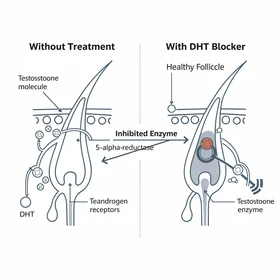
This is the fundamental distinction that matters more than any other comparison point. DHT is the cause of androgenetic alopecia in men. It binds to follicle receptors and shrinks them over successive growth cycles until they stop producing visible hair. Procerin addresses this cause by reducing DHT production through natural 5-alpha-reductase inhibition.
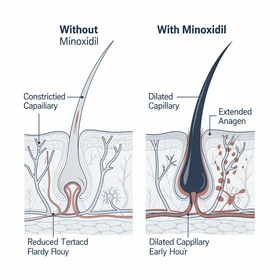
Rogaine does not affect DHT at all. It stimulates growth through vasodilation and potassium channel activation, extending the anagen (growth) phase and increasing follicle size. This produces visible results, but the underlying DHT-driven damage continues in the background. Think of it this way: Rogaine makes your follicles grow faster while DHT continues shrinking them. Procerin removes the thing that is shrinking them.
Neither approach is wrong. They target different parts of the problem. But understanding this distinction helps you make a smarter choice based on your specific situation.
When to Choose Procerin
- You want to address the root cause. If your goal is stopping or slowing the miniaturization process itself, DHT blocking is the mechanism that does that.
- You are in early stages (Norwood I-III). At this point, your follicles are still active and responsive. Reducing DHT exposure before significant damage accumulates produces the best long-term outcomes.
- You want to avoid scalp irritation. Minoxidil causes dryness, flaking, and irritation in a meaningful percentage of users. Procerin's oral tablets avoid this entirely, and the XT foam is better tolerated than alcohol-based minoxidil solutions.
- Side effect avoidance is a priority. Procerin has no reported sexual or systemic side effects in its clinical study. Minoxidil can cause unwanted body/facial hair growth and cardiovascular effects in rare cases.
When to Choose Rogaine
- Crown thinning is your primary concern. Minoxidil has strong evidence specifically for vertex (crown) regrowth. It works well in this area even without DHT management.
- You want FDA-approved status. Rogaine is FDA-approved for hair loss. Procerin is a dietary supplement (not FDA-approved as a drug). If that distinction matters to your comfort level, Rogaine has the regulatory backing.
- Budget is the primary factor. Generic minoxidil starts at $15/month. Procerin is $30-40 (or $24-32 with code REMEMBER).
- You do not want to take oral supplements. Rogaine is topical-only. Some men prefer not to ingest daily capsules.
Why Many Men Use Both
Because the mechanisms are complementary, combining Procerin and Rogaine addresses hair loss from two independent angles simultaneously:
- Procerin reduces DHT, halting the cause of miniaturization
- Rogaine stimulates growth and extends anagen, promoting recovery and thickness
- Published research on combination approaches (DHT blocker + minoxidil) consistently shows the highest improvement rates, up to 94% in some studies
If you are starting fresh and want the best probability of visible improvement, using both is the evidence-supported approach. Start with Procerin alone for 30 days to establish the protocol, then add minoxidil if you want the combination benefit. For practical guidance on combining approaches, hair regrowth strategies covers multi-product protocols in detail.
The Practical Differences
Convenience
Procerin tablets are 2 capsules with food (30 seconds). The XT foam is applied twice daily (2 minutes each). Rogaine liquid requires measuring with a dropper and letting it dry (can take 15-20 minutes without touching your hair). Rogaine foam is faster but still requires twice-daily scalp application. Both products demand daily consistency.
Cosmetic Impact
Minoxidil liquid can leave hair looking greasy or crunchy, which affects styling. The foam is better. Procerin's oral capsules have zero cosmetic impact. The XT foam dries clear and does not affect styling once dry.
What Happens When You Stop
Both products require ongoing use. Stopping Procerin means DHT levels return to baseline and miniaturization resumes over months. Stopping Rogaine means the growth stimulation ceases and gains reverse within 3-6 months (often faster than Procerin reversal because the underlying cause was never addressed).
What to Watch Out For
Limitations and Considerations
- Neither product works for everyone. Approximately 13% of Procerin clinical study participants did not see meaningful improvement. Rogaine non-response rates are similar (roughly 40% see no visible change).
- Rogaine's initial shed is psychologically difficult. Many users quit during weeks 2-4 when shedding temporarily increases. This is the treatment working (pushing out old hairs for new growth), but it feels like the opposite.
- Minoxidil can cause unwanted hair growth. Facial hair, arm hair, and body hair growth are reported side effects, particularly with liquid formulations that drip onto the face or pillow.
- Cost over time adds up for both. At $30-40/month for Procerin and $15-30/month for Rogaine, a combination approach runs $45-70/month indefinitely. Budget accordingly.
- No treatment reverses fully dormant follicles. Both products work best when started before extensive follicle death. Norwood V+ with long-established baldness needs surgical options, not topicals or supplements.